A sub-15ms wake, 5MB idle footprint buffer engineered in front of Obsidian and Notion.
Armed with an autonomous IME shield and air-gapped local AI for instant thought capture.
Modern knowledge vaults like Obsidian or Notion excel at long-term synthesis, but multi-second load times break cognitive momentum.
MD-Memo does not replace your vault. It is the zero-friction buffer standing directly in front of it.
| Dimension | Standard Text Editors | Knowledge Vaults (Notion / Obsidian) | MD-Memo |
|---|---|---|---|
| Architecture | C++ / Swift / Rust | Electron / Chromium (Heavyweight) | Go 1.26 + OS-Native WebView |
| Summon Latency | ~100ms (Cold boot) | 2.0s – 5.0s (JS runtime init) | < 15ms (System tray resident) |
| Idle Memory | ~15 MB | 400 MB – 800 MB+ | 5 – 15 MB (Aggressive GC reclamation) |
| IME Handling | OS default (Typos in code) | OS default | Autonomous IME Shield (Syntax Guardian) |
| AI Assistance | Cloud-only (Paid / API key) | Cloud-only / Third-party plugins | Air-gapped Local (Ollama) / Optional Cloud AI |
| Storage Model | Plain text | Proprietary DB / Vendor Cloud Sync | 100% Local POSIX Plain Text |
Unobtrusive, instantaneous, and never interrupting your train of thought. Engineering poured into every nuance.
Instantly summon from the system tray via Ctrl+Alt+M (macOS: from the Dock via Option+Cmd+M). On window minimize, debug.FreeOSMemory() aggressively shrinks the working set to 5–15 MB.
Automatically intercepts full-width CJK characters inside inline code (`...`), code fences, and URLs. Log-Likelihood Ratio Testing (LLRT) catches accidental direct-mode Romaji typos.
Pair with offline Ollama / vLLM instances without data leakage. Press Ctrl+→ to accept high-speed predictive completions. Optional cloud models available for complex reasoning.
Pipe terminal streams via cat build.log | md-memo to running instances over local TCP IPC. Press Ctrl+E for the Command Bar: type a shell command, or press Tab to switch to AI mode for natural-language OS commands that a local safety guard checks before they run.
Harnesses runtime.NumCPU() worker threads and a zero-allocation parallel scanner to search across all daily scraps (scraps/YYYY-MM-DD.md) instantaneously.
Auto-commits and pushes in the background after 30 seconds of keyboard idle. Auto-rebases on launch. Provide an empty Git repository URL in settings for effortless multi-device sync.
Select text (or just place the caret), press Ctrl+L and type an instruction: the built-in LLM's answer is inserted right below it in seconds, and your own text is never replaced. Alt+C proofreads with no instruction at all.
Write a line and press Ctrl+Enter: fixed local rules decide whether it goes to the built-in LLM, an agent CLI (Claude Code, Codex, Hermes, Antigravity) or a command. The result lands below your line. By default agents and commands wait for a second press; when the rules are unsure, the Ask AI bar opens. Write {{ @agent ... }} yourself; agents live in agents.yaml.
Not sure what to do? Press Ctrl+J for up to three next steps for what you are writing. It runs on built-in local rules by default, so nothing leaves your machine, and every shell command passes an AST guardrail first. Click the status-bar Action badge to switch between On, Manual and Off.
Ctrl+V converts HTML from Excel, Word or Google Docs into Markdown — tables, lists, code blocks and links included — with no external converter, and runs vision OCR when the clipboard holds only an image. Code and logs from editors and terminals stay as they are. Ctrl+Shift+V pastes as it is, with no conversion. About 1 MB of HTML converts in roughly 90 ms.
Start dictation from the toolbar microphone, the right-click menu, the command palette or a configurable shortcut (Ctrl+Shift+R by default); a marker at the caret tracks progress while you keep typing elsewhere. Recording stops after a few seconds of silence or a second press of the shortcut, and Esc discards it. The default model is Gemini 3.5 Transcribe, and it needs an API key in Settings, shared with image OCR.
Drop a file onto the editor to insert a link at the caret; it is copied into ./assets so the link keeps working. Ctrl+Click opens it with the OS default app, Alt+Click reveals it in Explorer or Finder, and hovering an image link shows a thumbnail.
Press Ctrl+Shift+U for a QR code that opens a page on your phone over the same Wi-Fi (or a Cloudflare tunnel for HTTPS). Send photos, voice notes, files and text in one batch — up to 10 files and 60 MB — and pull the PC's current selection over as text too. If OCR or transcription cannot run, the photo or recording is still saved to ./assets and linked.
Choose which toolbar icons and right-click menu items are shown, and reorder them within their group, from Settings → General. Changes apply immediately, Cancel undoes them, and Reset to default restores the original layout; hidden items keep working from their keyboard shortcut.
External tools and AI agents can read just the text you have selected with md-memo buffer get --selection and write the result back with md-memo buffer replace-selection. The write is a single undo step, and if the selection moved in the meantime nothing is written.
Open a folder with Ctrl+Shift+O and the two notes that best match what you are typing appear as pills in the status bar; click one to open it in a new tab. Matches are scored by plain keywords against the titles, first lines and paths of the Markdown and text notes in that folder. No folder or no match means no pills.
Every action in Settings → Shortcuts can be rebound: click its key button and press the new combination. A combination already in use asks before it is overwritten, and reserved keys such as Ctrl+Shift+V are refused. Backspace clears a key, and Reset to Defaults restores them all.
The repository ships skills/md-memo, a source-verified reference of every interface, config file and setup step, so an AI agent can operate or configure MD-Memo for you. It covers the CLI, JSON-RPC and the safety rules: config.json is edited only while the app is closed, and keys are never printed.
Automated visual-to-markdown structuring, guarded OS terminal execution, multi-core Grep search, and instant text diagramming.
Snip screenshots or UI mocks with OS shortcuts (Win+Shift+S / Cmd+Shift+4) and press Ctrl+V inside MD-Memo. Without opening external upload tools, visual content is transcribed directly into structured Markdown.
[Transcribing Image (Gemini)...], ensuring your typing is never blocked.
| Column |), heading hierarchies, lists, and Mermaid diagram candidates.
```typescript), eliminating manual retyping.
Transforms your scratchpad into a living I/O bridge with your OS and terminal. Generates shell commands from plain-English prompts with AST-level safety enforcement.
cat build.log | md-memo or docker logs ... | md-memo. Ingests stdout into daily scraps (scraps/YYYY-MM-DD.md) via TCP IPC in milliseconds.
jq, prettier, or sort and replace the selection in-place with formatted output.
md-memo buffer get --selection prints the current selection; md-memo buffer replace-selection writes it back as one undo step, keeping the result selected.
Resolve "Where did I write that note?" in zero seconds. Press Ctrl+Shift+F (macOS: Cmd+Shift+F) to scan all accumulated daily scraps concurrently in memory.
bufio.Scanner execute zero-allocation memory scans across thousands of past files instantly.
↓/↑, hit Enter to open the scrap, smooth-scroll to line, and highlight.
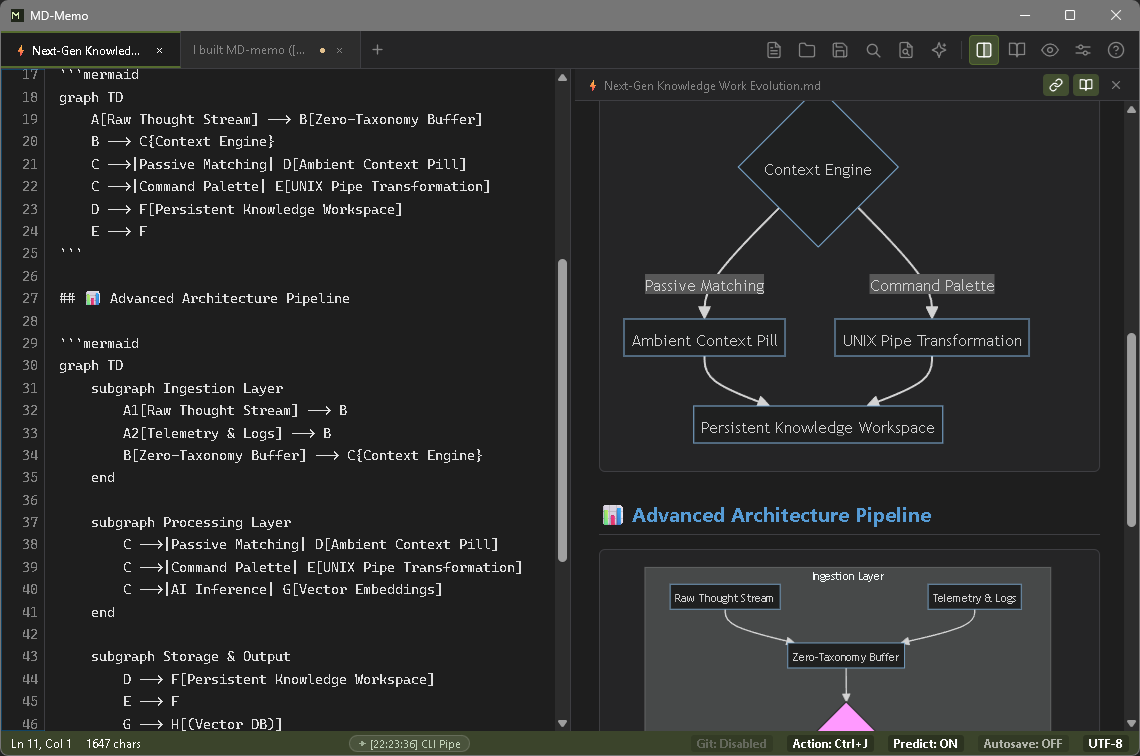
Synthesize complex documents into concise visual diagrams in seconds. From verbose specifications to error flows, AI extracts relationships and renders Mermaid diagrams in real-time split view (Ctrl+\).
Ctrl+\. Eliminates external drawing tool startup overhead and accelerates comprehension instantly.
Stripped of cognitive noise, gradients, and superfluous ornaments. Pure typography and markdown elegance.
Woven seamlessly into the daily workflows of designers, engineers, developers, and researchers.
Overlay MD-Memo over Figma or browser windows with a single hotkey. The autonomous IME shield prevents mode-switching typos even when alternating between English terminology and CJK languages.
Author UI states and modal transition logic in text while inspecting real-time Mermaid diagrams (Ctrl+\). Documentation and architectural diagrams remain synchronized as pure plain text.
Run docker logs ... | md-memo or curl ... | md-memo to stream terminal output straight into your buffer. Apply jq or prettier from the Command Bar (Ctrl+E) and ask the AI about the result with Ctrl+L.
Set MD-Memo's storage folder directly to your active Obsidian Daily Notes/ directory. Rapid daily brain-dumps happen in zero-lag MD-Memo, and are reviewed in Obsidian's link graph at dusk.
Scan the Mobile Drop QR code, snap the whiteboard, add a quick voice note, and press "Send all". Photos go through vision OCR and voice notes through Gemini transcription, arriving as one heading per item in your scratchpad.
Copy cells in Excel or a table in Word and press Ctrl+V. The built-in converter turns the clipboard HTML into a GFM table with column alignment; Ctrl+Shift+V pastes the text only, as it is.
Never reach for your mouse. Every core action is tuned for fingertip reflex.
[ Frontend: Monospace Canvas / Ghost Overlay / Scrap Search UI ]
▲
│ Bi-directional RPC Bridge (WebView2 / WKWebView)
▼
[ Core Engine: Go 1.26 / OS-Native WebView / Native Panels (COM/Cocoa) ]
│
├─► CLI Pipes & TCP IPC (127.0.0.1:49152)
├─► Air-Gapped Local LLM Engine (Ollama / vLLM / LM Studio)
├─► Daily Scraps Aggregator (scraps/YYYY-MM-DD.md)
├─► Parallel Grep Engine (runtime.NumCPU() Zero-Allocation Scan)
├─► Background Git Sync (Silent Push after 30s Idle)
├─► Direct File I/O (Auto-Encoding Detection)
└─► Aggressive Memory Reclamation (Active GC on Hide: 5–15 MB)